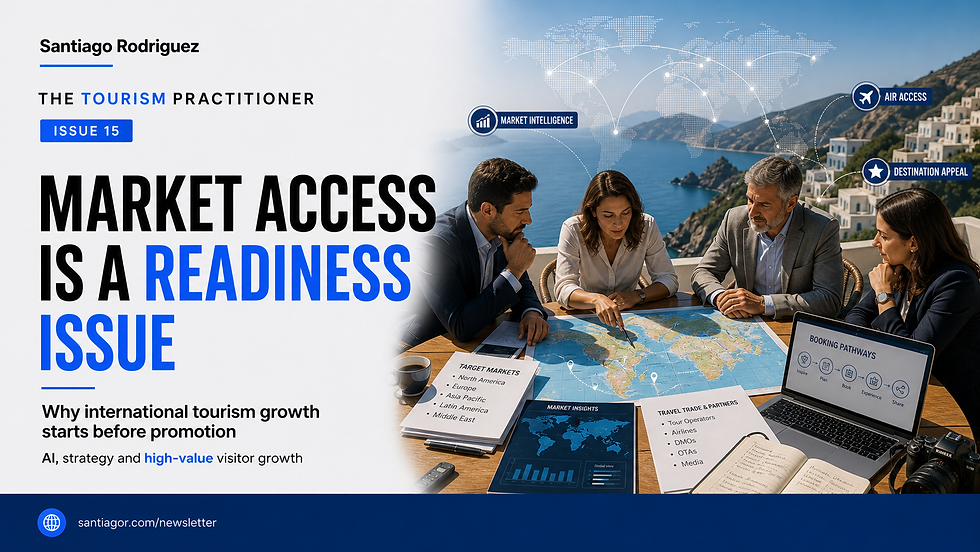
Market Access Is a Readiness Issue
Most conversations about international tourism growth start too late.
They start with promotion.
Which market should we advertise in?
Which campaign should we launch?
Which creators, trade partners, ads, fairs, or social platforms should we use?
Those questions matter.
But they are not the first questions.
Because international market access is not only about becoming visible to foreign visitors.
It is about becoming ready for the right foreign visitors to notice you, understand you, trust you, reach you, book you, experience value, and create value with you.
That is a much bigger strategic problem.
Why This Matters Now
AI makes international ambition feel easier.
You can research markets faster.
You can compare visitor segments.
You can generate multilingual content.
You can draft outreach messages, campaign angles, itineraries, trade briefs, and market summaries in hours instead of weeks.
That acceleration is useful.
But it can also hide a weak foundation.
If the target market is vague, AI will help you produce vague campaigns faster.
If the destination cannot coordinate its offer, AI will not create trust among actors.
If the experience does not justify distance, price, time, and risk for the segment you want, more content will not solve that gap.
If a business does not know how international visitors discover, evaluate, book, and access its offer, promotion may create interest without conversion.
So before asking AI to help you reach international markets, ask whether the tourism system is ready to enter them.
The Common Mistake
The common mistake is treating market access as an external marketing task.
In that view, the destination exists.
The product exists.
The only remaining job is to push the message abroad.
But tourism does not internationalize like a poster.
A foreign visitor evaluates distance, effort, trust, information quality, language, reputation, access, safety perceptions, booking pathways, service expectations, price, and meaning.
At the same time, the destination needs collective initiatives, market intelligence, operational capability, institutional structure, commercialization routes, and enough learning capacity to adapt.
That is why the same condition can become either a barrier or an enhancer.
No reliable target-market information is a barrier.
Reliable target-market information is an enhancer.
Disconnected actors are a barrier.
Collective initiatives are an enhancer.
Weak processes are a barrier.
Processes that can be sustained and improved are an enhancer.
The difference is readiness.
The Strategic Reframe
Market access is a readiness system.
It is the result of many conditions working together.
My research with Prof. Dr. Dominique Vanneste, PhD, at KU Leuven University, consolidated 46 determinants for tourist destinations' international market access. The useful lesson for strategy is not to turn those determinants into a checklist that sits in a file.
The useful lesson is this:
International growth depends on more than promotion.
It depends on whether the destination can organize itself around the right market opportunity.
The determinants span collective action, intelligence, management, promotion, government, communication, environment, economics, commercialization, and standards.
That breadth matters.
Because if international growth is treated as only a communication problem, leaders may miss the constraints that are actually blocking value.
A Practical Readiness Lens
You do not need to audit 46 determinants every morning.
But you do need a sharper lens before investing in foreign market growth.
I would start with five readiness questions.
1. Can the destination act collectively?
International visitors rarely experience one actor in isolation.
They experience a connected offer:
arrival,
accommodation,
activities,
interpretation,
service,
safety,
information,
payment,
trust,
local relationships.
If the actors who shape that value cannot coordinate around a target opportunity, the market receives fragmentation.
Collective readiness is not a soft issue.
It is market access capacity.
2. Do we know the target market and segment?
International growth becomes expensive when the target is generic.
The question is not only:
Which country should we target?
It is:
Which visitors from that market have the motivation, means, expectations, and fit for this destination or business?
That requires intelligence.
It requires information about demand, income segments, decision criteria, barriers, competitors, distribution pathways, and travel context.
Defined target markets are not a marketing detail.
They shape what the destination must become capable of doing.
3. Can the offer justify the journey?
Distance matters.
So do price, time, friction, perceived risk, reputation, and alternatives.
An offer that feels compelling to a nearby visitor may not be enough for a long-haul international segment.
Readiness means understanding the value equation from the visitor's perspective.
What is distinctive enough?
What is credible enough?
What is accessible enough?
What is meaningful enough?
International market access improves when the offer makes the trip make sense.
4. Can the visitor discover, trust, book, and access the offer?
Market access has commercial pathways.
Visitors need information and confidence.
Partners need clarity and reliability.
Bookings need channels.
Overseas customers need communication and support.
The destination or business needs the ability to work with distribution, digital channels, foreign representation, follow-up, sales closing, language, and standards.
Promotion without a pathway creates attention without enough action.
5. Can we turn barriers into enhancers?
The readiness lens is not about declaring a destination ready or unready forever.
It is about seeing where capability can be built.
A weak process can be improved.
An unclear segment can be defined.
A missing relationship can be developed.
A weak digital pathway can be redesigned.
A disconnected offer can become a collective initiative.
This is where strategy becomes practical.
Where AI Helps
AI is useful inside this readiness work when it helps professionals think, investigate, and decide more clearly.
For example, AI can help you:
structure a target-market assessment,
compare visitor motivations and barriers,
map a determinant as a barrier, enhancer, or unknown,
identify questions that require real research,
synthesize market signals into positioning implications,
draft multilingual content after the strategy is clear,
prepare outreach briefs for partners and campaigns.
The order matters.
Use AI first to improve intelligence and decision quality.
Then use it to accelerate content and outreach.
A Practical Action For This Week
Choose one international market you want to grow.
Then create a one-page readiness map with five columns:
1. Collective capacity 2. Market intelligence 3. Offer and operations 4. Access and commercialization 5. Learning gaps
Under each column, write:
what is already an enhancer,
what is currently a barrier,
what remains unknown,
what you should investigate next.
That one page will give you a better starting point than another generic international campaign brainstorm.
Final Thought
Destinations do not access international markets by posting more.
They access markets by becoming more ready.
Visibility matters.
Promotion matters.
Content matters.
But readiness determines whether attention can become trust, bookings, experience quality, and long-term value.
Whenever you're ready, here are more ways I can help you grow your business or destination.
Test practical AI tools built for tourism strategy, market intelligence, forecasting, content creation, LinkedIn posts, and destination storytelling.
A practical guide for tourism professionals who want to understand how to use AI with strategy, clarity, and confidence instead of collecting disconnected tools.
A self-paced, hands-on course that teaches you how to attract the type of tourism you want for your destination or business and gives you the tools to take action and track results.
Attract high-value visitors, boost your professional value, execute with AI, and turn strategy into action with guided support.
With the Herrmann Global team, we help you attract your ideal international visitors through market intelligence, multilingual content, online marketing, and travel trade activation.