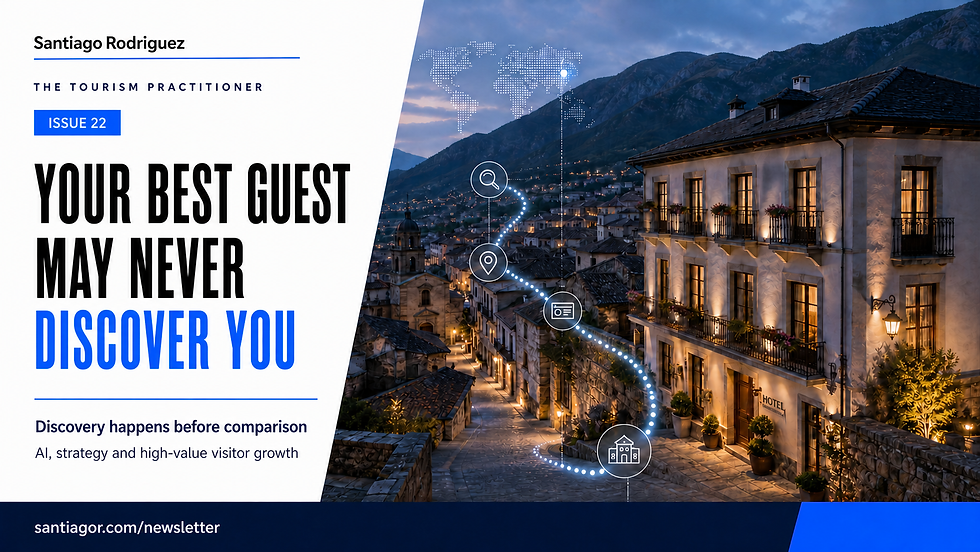
Your Best Guest May Never Discover You
A well-run hotel can have the right location, thoughtful service, strong reviews, and a genuinely distinctive experience.
And still remain invisible to the guest it is best suited to serve.
Not because that guest rejected the hotel.
Because the guest never found a clear reason to consider it.
That distinction matters.
Many hotel teams interpret weak direct demand as a promotion problem.
They invest in more images, more posts, more ads, or more polished descriptions.
But the real problem often begins earlier.
Before a traveler compares rooms, rates, or availability, they are trying to understand their own trip.
They are asking questions such as:
Is this the right kind of stay for me?
Why would this location make my trip easier, richer, or more memorable?
What is actually distinctive about this experience?
Why should I trust this promise?
What should I do next if this looks relevant?
If your hotel does not help answer those questions, it may never earn a place on the guest's shortlist.
The Cost Of Being Discovered Too Late
When a hotel is discovered only through an online travel agency (OTA), a generic destination search, or a last-minute price comparison, the decision becomes narrower.
The traveler sees availability, ratings, price, and surface-level features.
The hotel's local knowledge, service philosophy, distinctive experience, and evidence of fit appear too late, if they appear at all.
That leaves the hotel competing inside someone else's interface, on someone else's terms.
The result is familiar:
More dependence on paid distribution, more pressure to discount, and less opportunity to explain why the right guest should choose the property in the first place.
The Wrong Fix
The usual response is to publish more.
More destination photography.
More generic claims about hospitality.
More content calendar activity.
But discoverability is not a posting-volume problem.
It is a usefulness problem.
The hotel that becomes useful before comparison earns a different kind of attention. It helps a traveler make sense of a trip before the traveler starts filtering a list of properties.
The Intent-To-Evidence Map
To make that practical, use an Intent-to-Evidence Map.
Start with the questions a high-fit guest needs answered before comparison. Then match each question to evidence the hotel can genuinely provide.
Fit: Is this for someone like me? Evidence: Guest profiles, trip occasions, room suitability, service style, and atmosphere.
Place: Why is this location useful? Evidence: Walkability, access, local expertise, neighborhood context, and arrival guidance.
Experience: What will the stay feel like? Evidence: Specific moments, thoughtful service, practical details, and local recommendations.
Proof: Why should I trust it? Evidence: Reviews, credible stories, transparent information, and operational clarity.
Next step: What should I do now? Evidence: Clear booking paths, useful itineraries, direct answers, and relevant calls to action.
The objective is not to invent a story.
It is to identify what is already true, useful, and meaningful, then make it easier for the right traveler to understand.
Where AI Can Help
AI can make this work faster without replacing hotel judgment.
It can help a team organize guest questions, identify gaps between those questions and the current website or content, group existing evidence, and propose a connected set of useful assets.
For example, a hotel team can provide a guest profile, real offer details, location context, and a small set of reviews or proof points.
AI can help turn those inputs into a first Intent-to-Evidence Map.
The team still has to decide what is accurate, distinctive, commercially relevant, and worth promising.
That human judgment is the strategy.
What Changes When Discovery Improves
Better discovery does not mean persuading everyone.
It means helping the right people recognize fit sooner.
That can create a clearer path from search and curiosity to relevance, confidence, direct inquiry, and booking consideration.
It also gives the hotel a better content standard: before publishing anything, ask whether it helps a relevant traveler understand the trip, the place, the experience, the proof, or the next step.
If your content does not help travelers to understand their trip, it may be attractive content. But it is not yet useful discovery content.
A Practical Way To Apply The Method
If you want to apply this method through a structured, travel-specific workflow, Type Hero can help you define the hotel and stay offer, prepare a knowledge base with guest personas, brand voice, proof, and media, then connect that foundation to campaign planning, market research, and content that remains ready to publish directly from the platform.
All in one place.
It does not replace the judgment behind your positioning. It helps turn the things you already know about your hotel, guests, and place into connected evidence that is easier for the right traveler to discover.
Whenever You Are Ready, Here Are More Ways I Can Help You
1. Free AI Tourism Tools: Access nine practical tourism-specific AI tools designed to start exploring tourism strategy, intelligence, content, and outreach.
2. Try Type Hero: The visibility engine for hotels, tour operators, and travel advisors. Get found wherever travelers plan (Google, ChatGPT, Claude or Perplexity) and turn that visibility into direct bookings without paying intermediary commissions.
3. Tailored Insights & Marketing: For organizations and businesses that need an agency to run a data-driven content and marketing campaign with travel-trade activation, executed around their market, audience, and commercial priorities.